Costs
Part of An outdoor living contractor: checks matter more than a good first impression
The cheapest outdoor living bid: the one that omits the costs that matter
What professional outdoor work actually costs to deliver: licensed trades, permits, supervision, stand-down time and closeout, and why the cheapest bid omits them.
A contractor's price is not a material list plus labor. It includes the cost of doing the work properly: insurance, licensed trades, permits, supervision, time lost to weather, and the closeout paperwork that most homeowners never think to ask for. Bids that look impossibly cheap have usually removed one of those, and you find out which one later.
What to take away
- Compare bids on what they include, not on the bottom line.
- Licensed trades, permits and inspections are real costs with real value.
- Weather stand-down time is a genuine line item on outdoor work.
- Closeout documentation costs a few hours and is worth many times that.
What a complete price actually covers
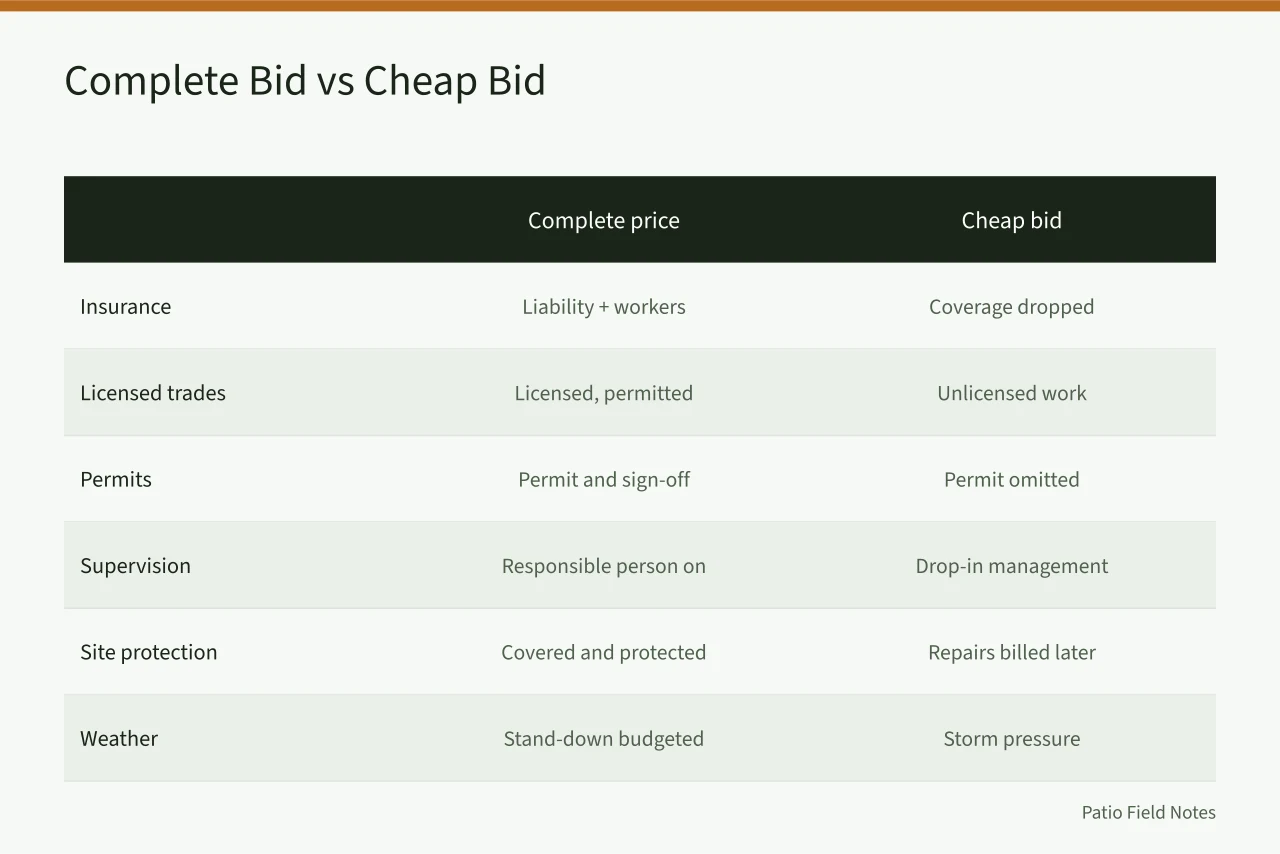
| Cost area | What it pays for | What a cheap bid usually drops |
|---|---|---|
| Insurance | Liability and workers compensation | Coverage, leaving risk with you |
| Licensed trades | Electrical, gas, structural work | Unlicensed or unpermitted work |
| Permits and inspections | Legal compliance and sign-off | The permit itself |
| Supervision | A person responsible on site | Drop-in management |
| Site protection | Covering open work, protecting neighbors | Repairs billed later as extras |
| Weather allowance | Stand-down time and rework | Pressure to work through storms |
| Closeout | As-builts, manuals, warranties | The entire package |
Ask each bidder to confirm which of these rows are included. The exercise usually explains most of the difference between quotes, and it does so without anyone having to defend their margin. The full version of that comparison is the seventeen hiring checks.
Stand-down time is not padding
Crews stop for storms, and a firm that has budgeted for that will not pressure its people to keep working. The National Weather Service's lightning outreach materials collect handouts, posters and toolkits aimed at organizations and workplaces, including an OSHA factsheet on lightning safety when working outdoors, which exists precisely because outdoor work and thunderstorms are a recurring combination.
When you see a weather allowance in a bid, that is a firm telling you it plans to stop. That is worth paying for. The lessons that follow from having, or lacking, such a policy show up repeatedly in real project experience.
Budget the closeout and the safety items
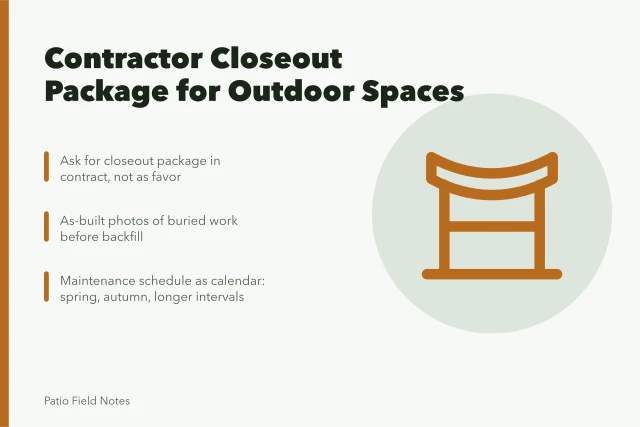
Two small lines repay themselves. The first is closeout documentation: photographs of concealed work, an as-built product list, manuals and warranty registrations. A few hours of someone's time, and the difference between a maintainable space and a mystery.
The second is the safety package: the U.S. Fire Administration publishes free home fire safety materials covering preparation, prevention, and at-risk household members. The formats are made to share, so the cost is time, not money.
Add carbon monoxide alarms in rooms adjoining any covered outdoor space. Put the grill and any heater on a pad in the open air at the manufacturer's clearance, and have the electrician label the outdoor circuits.
That last group is the part of the budget people cut when the total gets uncomfortable, and it is the part that has no financial upside and a serious downside. Nothing that burns fuel goes under a roofed porch or a screened enclosure. Carbon monoxide is odorless, and a ceiling holds it exactly where people sit.
Common questions
Why is the cheapest bid so much cheaper? Usually insurance, permits or supervision. Ask specifically about those three and the gap normally explains itself.
Is a design fee worth paying separately? Often. A designer with no installation to sell has no incentive to specify whatever is easiest to build.
How much should I hold back at the end? Enough to get the punch list finished, agreed in the contract at the start rather than argued at the end.
Do contractors charge for estimates? Some do for detailed ones, and a paid estimate is frequently more accurate. Ask whether the fee is credited if you proceed.