Rules
Part of 3 pointers on inside porch restoration that hold up
When does a porch restoration project trigger historic review?
When porch restoration rules require historic review: local district designation, a Certificate of Appropriateness, Section 106, and repair versus alteration.
Porch restoration rules sit on a line most homeowners do not know exists: the line between repair and alteration. Repairs generally keep the existing configuration. Alterations trigger current code, which may require rails, stairs and connections that the original porch never had. Which side you land on decides the scope, the cost and the paperwork — and, inside a locally designated historic district, whether a preservation commission has to approve the work.
What to take away
- Like-for-like repair and alteration are treated differently, and the threshold between them is set by local ordinance.
- Local historic district or landmark designation brings design review: a Certificate of Appropriateness, or the local equivalent, before work starts.
- Federal involvementa federal permit, license, funding or land — brings Section 106 review under the National Historic Preservation Act, run through the State Historic Preservation Office.
- Guard height, baluster spacing and stair geometry are the details most often brought up to current code, and the Secretary of the Interior's Standards for Rehabilitation are the yardstick local commissions usually borrow.
What usually triggers review
Historic review is triggered by designation, not by the age of the house. The tests a commission applies are:
- Local designation.The property is individually designated a local landmark, or it sits inside a locally designated historic district. That district is created by a local ordinance, adopted under state enabling law, and the ordinance is what gives the commission its authority.
- Contributing status.Inside a district, review usually covers only contributing buildings — those that date from the district's period of significance and keep their historic character. Non-contributing buildings commonly need only a building permit.
- Visibility from a public right-of-way.Most ordinances reach work on porches and facades visible from the street and leave rear and interior work alone.
- Scope: repair versus alteration.Painting, replacing a few boards in kind, and repointing with matching mortar are often exempt. Rebuilding a railing, changing a column profile, enclosing a porch or replacing stairs is an alteration and needs review.
- Federal involvement.If a federal agency funds, licenses or permits the project, Section 106 of the National Historic Preservation Act applies and the State Historic Preservation Office is consulted, whether or not a local district exists.
Listing on the National Register of Historic Places by itself does not restrict what a private owner does with a porch. It matters for Section 106 and for federal historic preservation tax incentives, not as a local approval trigger.
| Element | Often reviewed by | Why it comes up |
|---|---|---|
| Structural repair or replacement | Building department | Load path, connections, footing depth |
| Guardrails and handrails | Building department | Height, spacing and graspability rules |
| Stairs | Building department | Rise, run and landing dimensions |
| Roof and its connection to the house | Building department | Wind uplift and water detailing |
| Visible detailing and materials | Historic commission | Appearance rules within a district |
| Porch lighting and outlets | Building department | Licensed electrical work, inspected |
Two offices can both have a say, and they do not coordinate for you. The building department cares about safety and structure. The preservation commission — sometimes called a historic district commission, an architectural review board or a landmarks commission — cares about appearance and historic fabric, and it applies the Secretary of the Interior's Standards for Rehabilitation. Their answers can conflict, and resolving that is a design task best done before ordering anything, alongside the items in the porch restoration checklist.
Railing conflict resolution
Does code require taller guard or tighter baluster spacing than the original porch had?
Use alternative compliance, set-back second rail, or custom profile at required dimensions
Keep the original railing profile as the commission expects
Building Dept vs Historic Commission
Building department
- Structural repair
- Load path, footings
- Guardrails
- Height, spacing
- Stairs
- Rise, run, landing
- Roof connection
- Wind uplift, water
- Visible detailing
- Not primary
- Lighting and outlets
- Licensed, inspected
Historic commission
- Structural repair
- Not primary
- Guardrails
- Original profile
- Stairs
- Not primary
- Roof connection
- Not primary
- Visible detailing
- Appearance rules
- Lighting and outlets
- Not primary
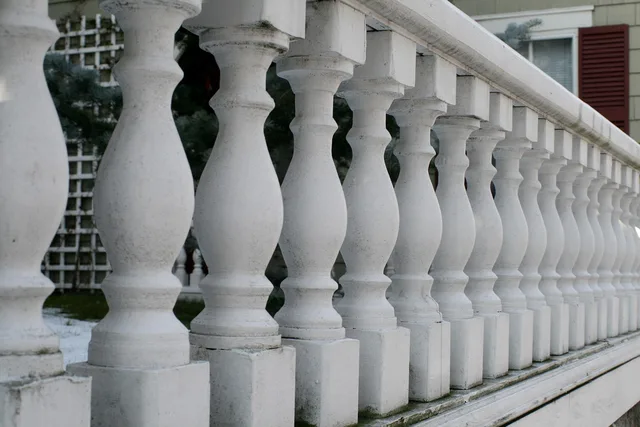
The classic conflict is a railing: current code may require guard height and baluster spacing the original porch never had. The commission wants the original profile preserved, but most jurisdictions offer a route through this.
That route may be an alternative compliance path, a set-back second rail, or a custom profile at required dimensions. Ask both offices the same question the same week, and ask each how they resolved it on other nearby properties.
Two examples show where the line falls. Replacing a few rotten floorboards with matching tongue-and-groove is repair, and in many districts it needs no commission approval. Rebuilding that same floor in composite decking, or swapping the original square balusters for a different profile, is an alteration: it changes the visible detailing and materials, so the application goes to the commission before anything is ordered.
Fire rules are adopted locally too
Fire codes are national documents adopted and amended locally, which is why answers differ across a county line. Historic preservation rules follow the same pattern: state law enables the district, but the local ordinance sets the review triggers and the application. Community programs work the same way.
The U.S. Fire Administration describes how a community becomes fire adapted in seven steps. It starts with a collaborative local group, a written assessment of risks, and actionable steps, all decided at community level, not nationally.
The National Fire Protection Association's Firewise USA program is a national framework that neighborhoods apply locally, teaching residents how to adapt to living with wildfire. In participating areas, the expectations for porch materials, stored goods and clearances can be more specific than the base code, and they change what a restoration should specify.
How to get a clean answer
Write two paragraphs describing the work: what is being repaired, what is being replaced, whether the roof or structure is affected, whether rails or stairs are being rebuilt, and whether any wiring is involved. Send it to the building department and to the commission separately, and ask each what application it needs — a building permit from one, and a design review application, usually called a Certificate of Appropriateness, from the other. Ask both to confirm what applies in writing.
Keep both replies. A dated written answer naming the reviewer resolves site disputes, satisfies future buyers, and gives your contractor something to build to. It also sets the sequence for approvals and ordering described in the stage-by-stage restoration guide.