Rules
Part of Grading decides whether outdoor space makeovers actually last
Can one contractor handle an outdoor space makeover's grading and drainage together?
How to vet a contractor for an outdoor space makeover: whole-yard work needs a firm that handles grading, drainage and planting together. What to check.
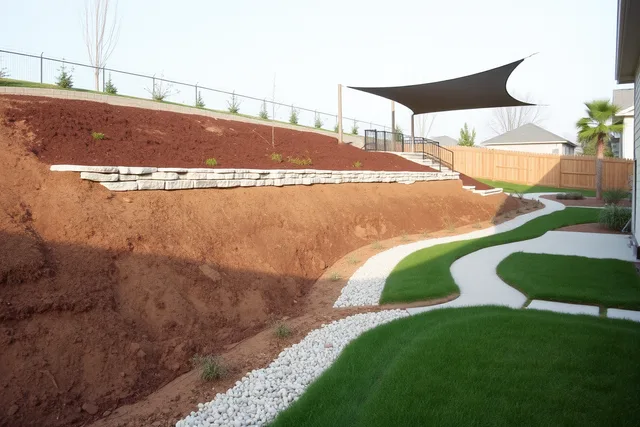
A whole-yard makeover spans more trades than a patio: earthworks, retaining, drainage, and hard surfaces. It also includes electrical and planting, and some firms cover all while others subcontract most and a few pretend.
The vetting question is who owns the interfaces between those trades, not who is friendliest. A homeowner checklist for patio furniture systems in 2027 also helps track who owns each trade interface during a whole-yard makeover.
What to take away
- Ask who is responsible where two trades meet, since that is where makeovers fail.
- Grading and retaining are engineering work; ask what triggers a professional design.
- Ask how the firm keeps up with hazards specific to your region.
- Check that planting responsibility and establishment care are defined in writing.
Questions about the interfaces
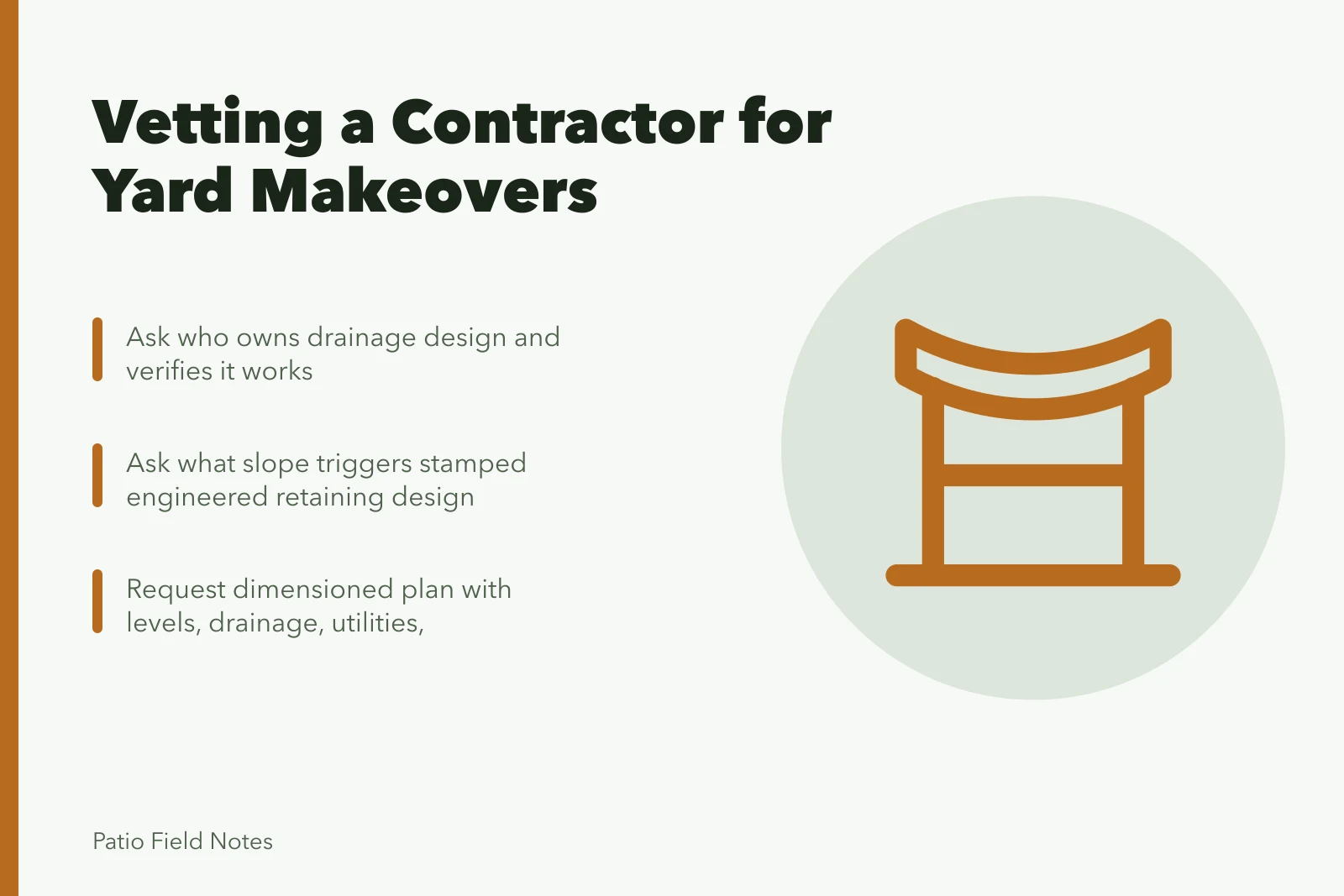
- Who sets the finished levels, and how are they recorded before planting covers them?
- Who owns the drainage design, and who verifies it works before the surfaces go down?
- At what height or slope does retaining become an engineered design with a professional stamp?
- Who protects finished surfaces while later trades are still working?
- Who is responsible for plant establishment, for how long, and under what watering assumptions?
- What happens to the schedule if the planting season is missed?
Those six questions separate a coordinated makeover from a sequence of subcontractors handing off problems. They also expose whether the firm has thought about the ordering set out in the makeover timeline.
Six contractor interface questions
- Who sets finished levels?
- Who owns drainage design?
- When is retaining engineered?
- Who protects finished surfaces?
- Who handles plant establishment?
- What if planting season missed?
Test how they keep up
Good firms follow research and revise their practice, while weaker ones repeat what worked a decade ago.
The U.S. Fire Administration publishes work on research and emerging technology for wildland fire, including dashboards that summarize national wildfire activity and analyses of how specific fires behaved.
You do not need a contractor to read it. In a fire-exposed region, a firm that follows something of that kind updates its specifications.
Ask a simple version of the question: what have you changed in the way you build over the last five years, and why? A specific answer, a fastener class, a base detail, a material substitution, tells you they are paying attention. A general answer about quality tells you nothing.
Test their local hazard knowledge
Ask directly what your region's dominant hazard is and what it changes about the design. In coastal areas, that answer should include wind.
The National Hurricane Center's hurricane hazards overview sets out the range of dangers these storms bring. A coastal contractor should say what it means for structures, fixings and stored items in a finished yard.
Inland, the answer might be frost depth, expansive soils, hail, or drought restrictions. Whatever the region, a firm that cannot name its dominant local constraint is building from a template.
The same holds for safety rules that survive the handover. Appliance clearances taken from manuals, licensed electrical work, and nothing that burns fuel under a roofed porch or screened enclosure, since carbon monoxide is odorless and gathers under a ceiling.
Put the plan on paper
Ask for a dimensioned plan with levels, drainage, hard surfaces, utility runs and planting, and ask who owns it if you do not proceed. Ask for the plan to be updated as built.
That drawing is the document a future contractor, a buyer or an insurer will want, and it makes the makeover patterns repeatable, not accidental.