Features
Part of Grading decides whether outdoor space makeovers actually last
Remaking a narrow outdoor space starts by removing things, not adding them
Small-space outdoor makeovers that actually work: courtyards, side yards and narrow lots, how to remake a small outdoor space, what to remove first.
Small outdoor spaces respond dramatically to makeovers, because the ratio of change to cost is high. They also punish clutter faster than any large yard, so the first act of a small makeover is usually removal rather than addition. Removal also exposes the faults beginners miss, like ponding water and hot surfaces that no amount of furniture hides.
What to take away
- Remove before you add. Most small spaces are carrying items nobody uses.
- One destination, one route to it, and everything else kept simple.
- Water access matters more in a small space, because it is used more intensively.
- Small spaces have no shelter of their own, so the retreat indoors has to be quick.
Start by taking things out
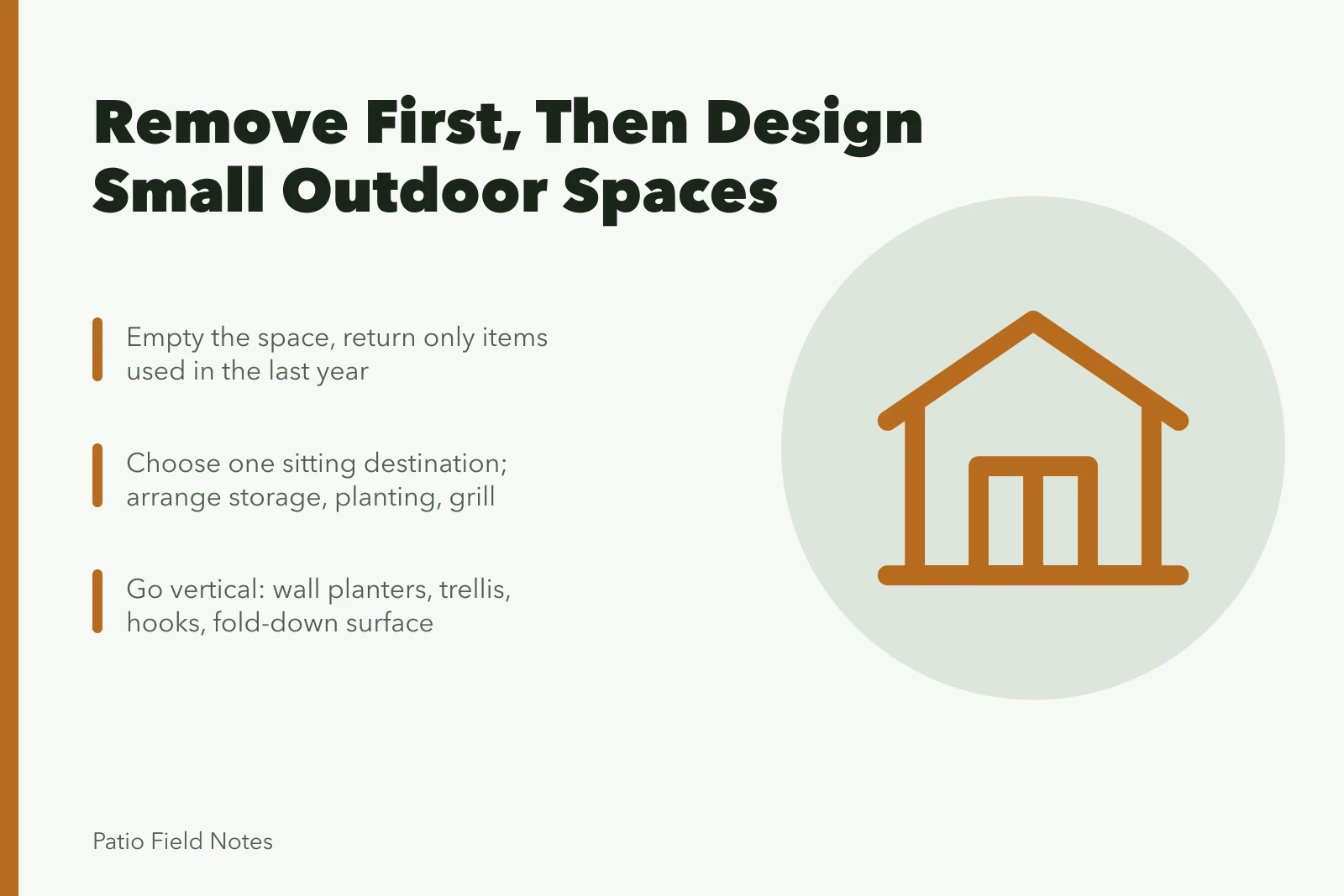
Empty the space completely if you can. Put back only what has been used in the last year. Most small yards and courtyards are carrying a broken chair, a bag of soil, three pots and a grill that has not been lit in two seasons. Removing them alone changes how the space reads.
Then decide the single destination: where people will sit. Everything else, storage, planting, the grill position, arranges around that. This is the same discipline as the single destination pattern applied to a footprint where there is no room for a second attempt.
The moves that work in a confined space
- Go vertical.Wall planters, trellis, hooks and a fold-down surface reclaim the floor.
- Use one surface material.Multiple materials cut a small area into smaller pieces.
- Light the edges, not the middle.Perimeter light makes a small space feel larger and avoids glare.
- Choose one large planter over five small ones.It reads calmer and dries out less quickly.
- Buy furniture that stacks.Small spaces need to be cleared for cleaning, work and storms.
Water is a design element, not an afterthought
Small spaces get used intensively, so the walk back inside for a glass of water happens constantly, and in heat that walk is the thing that ends the afternoon. A hose bib, a small drinks fridge on a proper outdoor circuit, or simply a large insulated jug changes how long people stay.
Storing water matters in a different way too. FEMA's Ready campaign explains how to build and maintain an emergency water supply, noting that clean drinking water may not be available following a disaster.
A compact outdoor space is a reasonable place to keep sealed water containers, provided they are shaded and rotated, and cool storage also serves the everyday purpose. Low-cost changes like this consistently outperform expensive ones, which is the pattern set out in small-space renovations that stay within budget.
Plan the retreat, because the space is not shelter
A courtyard with a canopy feels sheltered but is not. The National Weather Service's guidance on lightning safety indoors says safe shelters are buildings with electricity and plumbing, or metal-topped vehicles with windows closed.
Picnic shelters, dugouts, and small buildings without plumbing or electricity are not safe. A garden room with no services falls in that second group.
That page also notes that lightning enters structures in three main ways, including through wires and pipes that extend outside, which is why the advice indoors includes staying off corded phones and away from plumbing. In a small space the practical plan is short: umbrella down, cushions in, everyone into the house, and stay there.
Keep the combustion rule in the same plan. Grills, heaters and fire bowls stay in the open air, never under a canopy, an awning or a screened cover. Carbon monoxide is odorless, and a small covered volume fills faster than a large one.
Even in the open air, a covered patio needs its fasteners, flashing and gutters checked twice a year.