Industry
How Long Does a Paver Patio Take to Settle? A First-Year Timeline
A month by month first year timeline for paver patios: what normal settling looks like, when frost heave is expected, and when to call the contractor back.
What to take away
- A paver patio does most of its settling within the first 6 to 12 months, and a shallow dip of 1/8 inch to 1/4 inch over a few square feet is ordinary.
- Movement that grows after month 12, or a single drop of 1/2 inch or more, usually points to a base, compaction or drainage fault.
- The first winter is the hardest test, because water trapped in the base freezes and lifts the surface.
- Keep dated photos, a simple rain log and your invoice. A warranty claim depends on a pattern you can show.
- Workmanship warranties commonly run 1 to 5 years from substantial completion, so the start date matters.
Why a new paver patio moves at all
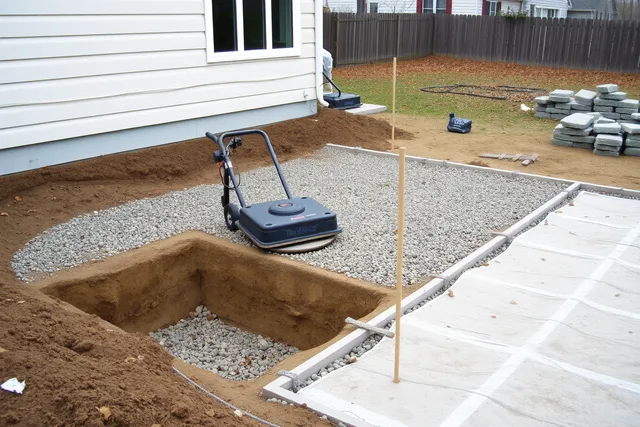
A paver patio rests on three layers: the subgrade soil, a compacted aggregate base and a bedding course of sand. Installation guides from the Interlocking Concrete Pavement Institute treat the base as the structural layer, not filler. Compaction is checked in lifts against a standard such as ASTM D698 or ASTM D1557.
The subgrade decides the outcome. Soil that holds water changes volume as moisture rises and falls. Clay that shrinks and swells can lift and drop everything above it, a mechanism described in the background on expansive clay soils.
You can learn a lot before a shovel moves. The USDA soil survey geographic database maps clay content and drainage class by location, so you can look up your soil series and ask whether the base depth suits it.
Month by month in the first year
| Period | Typical behavior | Call the contractor if |
|---|---|---|
| Month 0 to 1 | Bedding sand works into the joints and a few pavers sound hollow. | Water stands anywhere 24 hours after rain. |
| Month 2 to 3 | Small dips appear where the base was not uniform. | Edge pavers spread more than 1/4 inch. |
| Month 4 to 6 | Levels improve as traffic and rain compact the base further. | A dip deepens week after week. |
| Month 7 to 9 | A wet or dry spell nudges the subgrade volume. | A trip hazard appears. |
| Month 10 to 12 | The first freeze and thaw cycle tests drainage. | Pavers stay tented after the thaw. |
| After month 12 | The surface should be stable. | Movement restarts with no new cause. |
What normal settling looks like
Normal settling is slow, shallow and shrinking. Measure with a straightedge laid across the dip and a tape held down to the paver. A dip that measures the same in two checks a month apart is not active.
A quick checklist for the first year:
- No single dip deeper than 1/4 inch.
- No water standing 24 hours after a heavy rain.
- No paver rocking when you step on a corner.
- No widening gap along the edge restraint.
A patio that moves less each month is settling. A patio that moves more each month is failing.
Example: reading a one inch dip at month eight
Say you lay a four foot level across the patio and find a one inch dip near a downspout. That depth is past normal, and the location tells you why. Water leaving the roof and landing at the patio edge softens the subgrade, and the base loses support.
The fix is drainage plus a local base repair, not a layer of sand screeded over the top. Ask the contractor to correct the water source before reinstalling those pavers.
Frost heave in the first winter
Frost heave lifts a surface when water in the base freezes and expands. The mechanics of frost heaving explain why footings and bases must reach below local frost depth. A patio built on a shallow base over silty soil is the classic candidate.
Tented pavers in February are not always a defect. If they drop back flush by April, the base drained as intended. If they stay raised or crack, the base held water it should have shed.
When to call the contractor back
- Photograph the area with a tape measure in frame and note the date.
- Measure the dip with a straightedge and record the depth and width.
- Write down rainfall or irrigation patterns for the weeks before.
- Send written notice describing the change and the dates you observed it.
- Ask for a joint site inspection and a written repair plan.
Warranty periods and what they cover
Workmanship warranties commonly fall in the one to five year range, and the clock starts at substantial completion, not at the final invoice. Manufacturer warranties cover paver defects such as cracking or spalling, not base movement. Get the start date and transfer terms in writing.
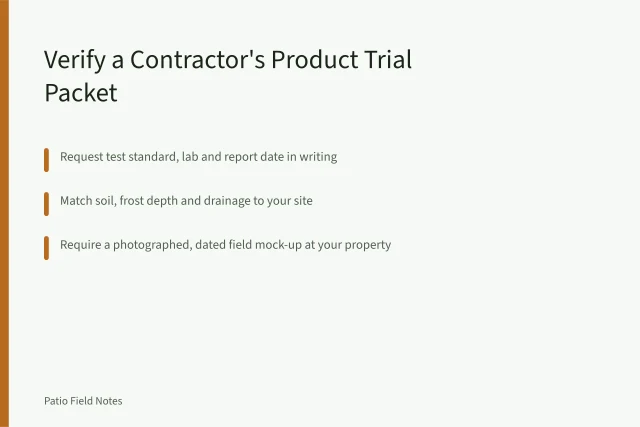
Before you sign, ask how the contractor proves a product suits your site. Our guide to what outdoor living contractors verify covers test standards, listings and field mock-ups.
Common questions
How long does a paver patio take to settle?
Most of the movement happens in the first 6 to 12 months. After one full freeze and thaw cycle, a patio on a well compacted base should hold its levels.
Is first year movement covered by warranty?
Base and drainage faults from workmanship usually are. Read the exclusions, because some contracts list settling as excluded entirely.
Does frost heave count as a defect?
Rise and fall with the seasons is expected in cold climates. Pavers that stay lifted, crack or heave unevenly point to a base depth or drainage problem.
Should I seal a new patio before it settles?
Wait at least one season, often a full year. Sealing too early traps moisture in the joints and hides the movement you want to track.