Industry
Deck Joist Tape and Flashing: The Hidden Layer That Decides Patio Cover Lifespan
How joist tape, ledger flashing and drainage details above the framing decide whether a covered patio survives year five, and how to write them into a bid.
What to take away
- Deck joist tape and flashing on a covered patio are the hidden layers above the framing that decide whether it survives year five.
- The details that fail first are the ledger, the post base on a pier and the low edge of a shed roof.
- Flashing moves bulk water, tape protects a wood surface, and a bid should name both in writing.
Where water reaches the framing
A covered patio roof sheds most rain, but water still arrives from the side. Wind driven rain crosses the open edge, and condensation drips onto joist tops.
The ledger board bolted to the house is the highest risk point. Water running down the wall sits on the ledger top. Without a membrane or metal cap, water enters the bolt holes and the end grain.
Wood takes on and releases moisture with the seasons, and end grain absorbs fastest, which is why a bare cut end rots first. Rot starts at the cut end, the notch and the drilled hole.
Joist tape: what it does and what it does not
Joist tape is a butyl or acrylic strip with a release liner, sold in rolls from about two inches wide. Products in wide use include Trex Protect and DeckWise Joist Tape.
Applied to the top of a joist, the tape seals the surface against ponding and covers screw holes as fasteners pass through. It slows wicking at a cut end when the end is taped before assembly.
Is joist tape worth it on a covered patio? In a wet climate, or under a roof that drips condensation, yes. In a dry climate with a well flashed cover, the gain is smaller and the cost is low.
Patio cover rot prevention comes down to keeping water off end grain and out of fastener holes.
Flashing details at the ledger and the posts
Flashing details on a patio roof have to hand water from one material to the next without an open gap.
Flashing details
| Detail | Common failure | What good work looks like |
|---|---|---|
| Ledger to house wall | Water tracks behind the board into the rim joist | Metal cap or peel and stick membrane tucked under siding and over the ledger top |
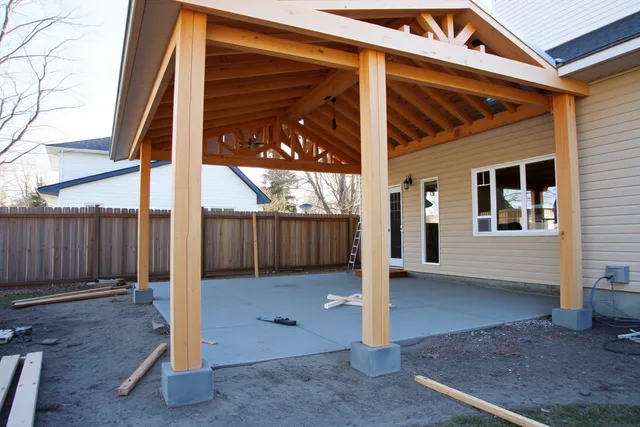
| Post base on a pier | End grain wicks water up the post | Standoff base, taped post end, no wood touching concrete |
| Roof to wall junction | Stains on the ceiling below | Step flashing woven with the siding and a kick out flashing at the bottom |
| Shed roof low edge | Water runs back under the panels | Drip edge, correct panel overlap and a gutter sized for the roof area |
Drainage, slope and the ground below
A gutter that ends at a post base simply moves the problem two feet. Roof water needs a discharge point that carries it away from the framing.
Roof panels need the fall the maker specifies, and deck boards under a cover need a fall away from the house so splash does not sit on the framing.
At grade, the ground should fall away from the structure. Six inches of fall in the first ten feet is the common rule.
Posts belong on piers below frost depth or on a standoff base above the slab.
Specifying tape and flashing in a bid
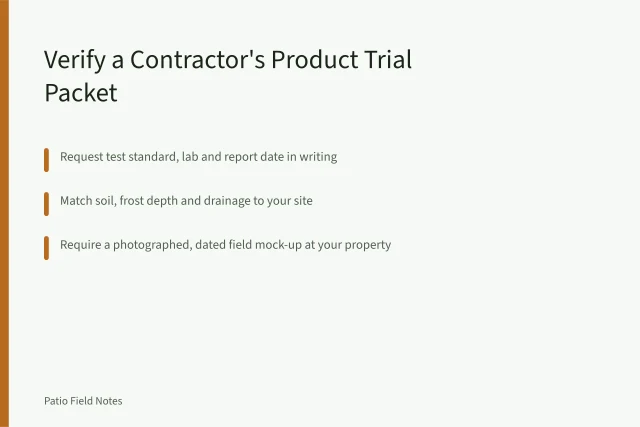
- Demand the tape product name and roll width in the written scope.
- Ask for the flashing metal at the ledger and the wall, including thickness and profile.
- Ask where roof water discharges, including gutter size and downspout location.
- Ask who returns in year one to check fasteners, caulk joints and post bases.
In Ontario, the Building Code Act governs when a permit is required, and a cover attached to a house usually needs one.
Canadian homeowners building patios should check what CMHC and CHBA programmes fund, since most shape financing and permits rather than the framing.
That is why the cheapest outdoor living bid is usually the one that omits tape, flashing metal and supervision.
Example: two bids for the same covered patio
Bid A lists framing, roof and paint at one price. Bid B lists joist tape on all framing, a metal cap at the ledger, step flashing at the wall, a gutter with two downspouts and a one year inspection.
Year five is where the difference lands.
What buyers and owners look for
Covered patio home value in Arizona tends to land near half to three quarters of build cost, so a dry, well flashed cover supports the number a buyer sees.
A low voltage patio lighting layout that avoids glare is easier to rough in while the framing is open, and it is the detail owners notice on the first evening.
The NFPA 70 National Electrical Code sets wiring rules for outdoor low voltage lighting and cable burial.
Patio cover maintenance checklist
- Look under the roof after the first heavy rain and note any drip on a joist top.
- Clear the ledger flashing and gutter of leaves each spring and fall.
- Probe joist ends, post bases and the ledger with an awl for soft wood.
- Reseal any fastener or caulk joint that has opened.