Industry
How to Check a Contractor's Product Trial Before Patio Installation
How to request, read and verify a contractor's product trial packet before patio installation, from test standards to field mock-ups and written questions.
What to take away
- Ask for the product trial packet before you sign, then read the test method, sample size, date and site conditions.
- Match the trial to your ground. Soil type, frost depth and drainage decide whether a result travels to your yard.
- Field mock-ups and current manufacturer listings are the two items contractors most often skip.
- A verbal claim of years of use is a starting point, not proof.
Why a trial beats a brochure
Product brochures describe a material in ideal conditions. A trial describes it under load, water and weather. The difference matters when a patio sits on clay or above a frost line.
Ask your contractor which products were tested on a comparable site. For a wider view of how contractors prove products, read the guide to test standards, listings and field mock-ups.
Four steps to request a trial packet
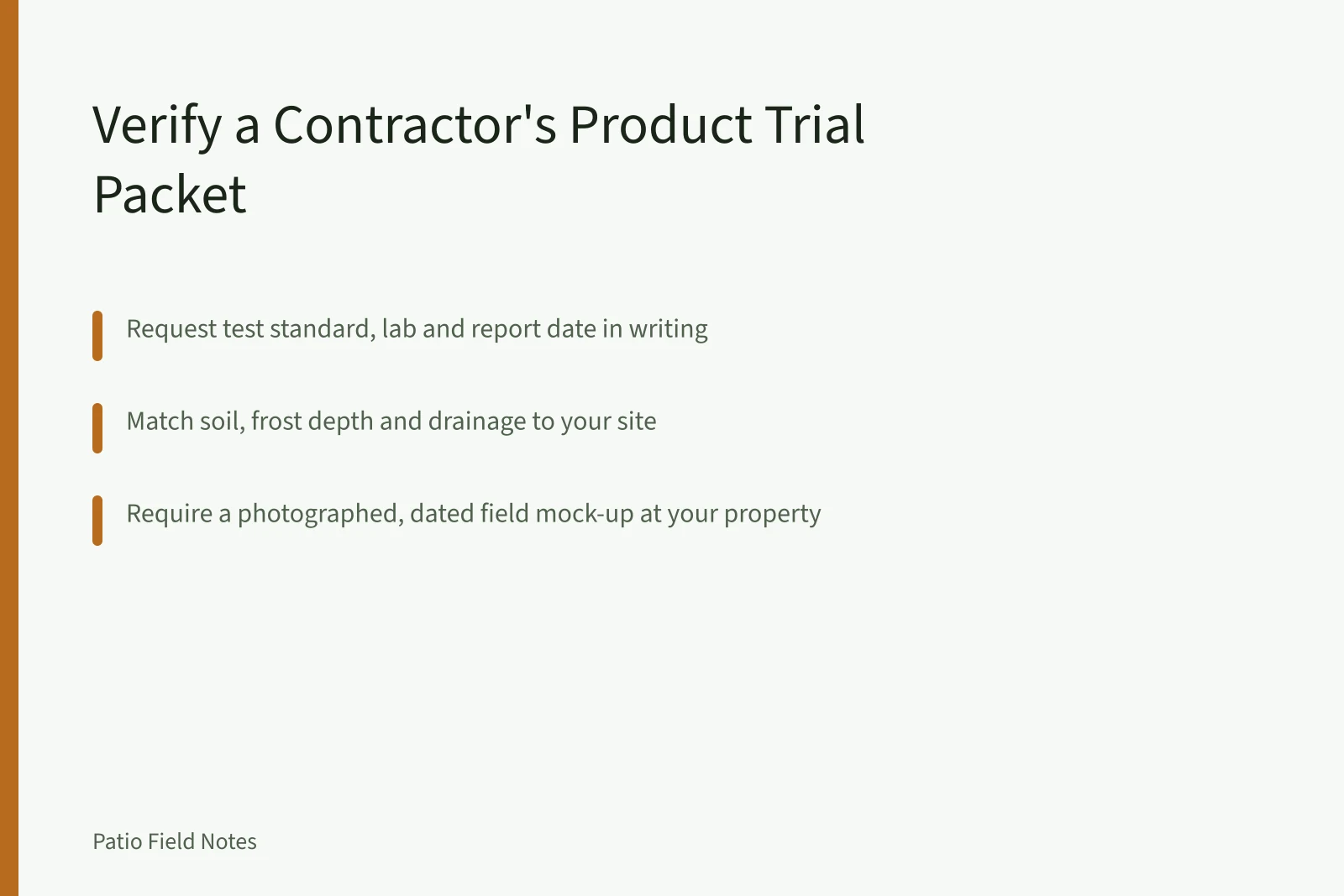
- Send a written request that names the product, the manufacturer and the exact assembly, not just the category.
- Ask for the test standard, the testing lab and the report date.
- Request site datasoil classification, local frost depth and the drainage plan.
- Require a field mock-up built at your property, photographed and dated.
Give the contractor ten business days. A supplier with real reports sends them quickly.
Reading the report line by line
| Report line | What it tells you | Warning sign |
|---|---|---|
| Test standard | Whether an independent method was used | Only a supplier demo video |
| Sample size and cure date | Whether the units match the ones you will buy | No dates or batch numbers |
| Site conditions | Whether the soil and drainage match yours | A generic claim with no detail |
| Report date | Whether the listing is current | A superseded edition |
Ask for the full report, not a summary page. Summaries drop the sample size, the cure time and the failure notes.
A report can be honest and still useless for your yard. Check that the soil, slope and freeze exposure in the trial resemble your site.
A trial that passes in sand tells you little about a patio on expansive clay.
Example: a paver base trial on expansive clay
Say a contractor proposes concrete pavers over compacted aggregate in a neighborhood with shrink-swell clay. Two checks take ten minutes.
Look up the parcel in the USDA soil survey to confirm the soil unit and its clay content.
Expansive clay soils shrink and swell as moisture rises and falls, which moves a base that was not designed for it.
Then ask three questions about the trial itself. Was the base built on clay or on sand? How thick was the compacted layer, and how was compaction measured? Where does water leave the patio?
Matching a trial to soil, frost and drainage
A passing result only transfers if the ground behaves the same way. Freeze and thaw is the usual gap.
In cold climates, base courses and footings have to reach below the local frost depth or they lift each winter.
Drainage is the second gap. A trial built on a slope with a daylight outlet says nothing about a flat yard that ponds.
Matching listings to the report dates
Manufacturer listings expire and get revised. Ask for the current edition of any code evaluation report, and check the report number against the manufacturer's own site. A superseded listing can describe an older mix or profile. Deck boards, railing and structural covers each carry separate listings.
Questions to put in writing
- Which test standard was used, and is that edition current?
- Which lab ran the test, and can I see the full report?
- Which site conditions were used, and how do they compare with mine?
- Will you build a mock-up at my property before the full install?
- What is the remedy if the installed product fails that same test?
Send the list by email so the answers are dated. Keep the reply with your contract and permit file.
Common questions
Do I need a trial report for every product?
No. Focus on items that carry load, hold water or face frost. Pavers, base aggregate, deck boards, footings and railing anchors matter most.
What if the contractor will not share the full report?
Ask for the manufacturer's published listing instead, including the report number and date. If neither appears, treat the product as unproven and consider another bid.
Can a warranty replace a trial?
No. A warranty covers replacement cost after a failure. It does not tell you whether the product suits your soil, slope and drainage.
How long should I keep the trial paperwork?
Keep it with your permits and receipts while you own the home. Buyers, inspectors and insurance reviewers may ask for it.