
Industry
Part of Patio Projects Planning: 3 Lessons
5 patio project patterns that repeat on almost every job
Five patterns that show up on patio jobs again and again, from base depth and buried conduit to storm stand-downs and the punch list nobody finishes.
Patio work has a small number of failure patterns and a large number of ways to arrive at them. These five come up so consistently that they are worth treating as design rules rather than as anecdotes. None of them is exotic, which is exactly why they keep happening.
What to take away
- Base preparation decides the outcome, and it is the easiest line item to quietly reduce.
- Buried conduit costs almost nothing during construction and a fortune afterward.
- A written weather stand-down rule prevents the argument about a rain-damaged base.
- Punch lists that are not written on the day of walkthrough do not get finished.
Lesson one: the base is the project
Every dispute about a settled patio traces back to excavation depth, compaction in lifts, or a base placed over soft, wet ground. The surface material gets the attention because it is the part you can see, but a first-rate paver on a poor base fails faster than a modest paver on a good one.
Ask for the base spec in writing and take a photograph before it is covered. That is one of the few construction records a homeowner can gather without expertise, and it is covered in the planning sequence.
Lesson two: run the empty conduit
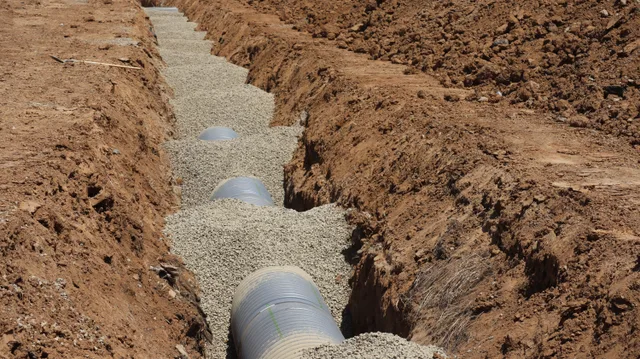
An empty sleeve under the patio costs a pipe's price and twenty minutes. Cutting a finished surface later costs demolition, mismatched replacement units, and a visible repair.
Run at least one sleeve to the far side and one to any future feature location. Cap the ends, mark them on a plan, and photograph the run before backfill.
Lesson three: storms stop work, so plan for it
An open excavation and a fresh base are vulnerable, and the argument about who pays comes after the rain. The National Weather Service's guidance on what to do during a thunderstorm is written for people, not projects. That priority is right: nobody should finish a course of pavers with thunder overhead.
FEMA's Ready campaign covers the household side of thunderstorm and lightning warnings, including what a warning means and when to move inside.
The project version is a clause: who covers exposed work, who decides to stop, and who pays if an unprotected base takes on water. Agree it before the first storm, not during it.
Lesson four: the appliance clearance is a design input
Fire pits, grills, chimineas and heaters get positioned late, after the surface is down, when the only option left is the spot that looks right. That is how a grill ends up against vinyl siding and a fire pit under a low branch.
Take the clearance from each manual, mark it on the plan at design stage, and treat it as fixed geometry. Local burn rules add another layer and vary by municipality and by season, so ask your fire department rather than assuming.
Anything that burns stays in the open air. Not under the porch roof, not inside the screen room, not under an awning. Carbon monoxide is odorless and a ceiling holds it at seated height.
Lesson five: write the punch list on the day
Walk the finished job with the contractor in daylight, notepad ready, and list lipped units, unfinished joints, missing edge restraint, damaged plants, and paint marks. Note any fixture that fails.
Items written on the walkthrough get fixed, but items remembered a week later become a negotiation. They are why final payment terms matter more than deposit terms, and setting those terms is part of building a realistic patio budget.